
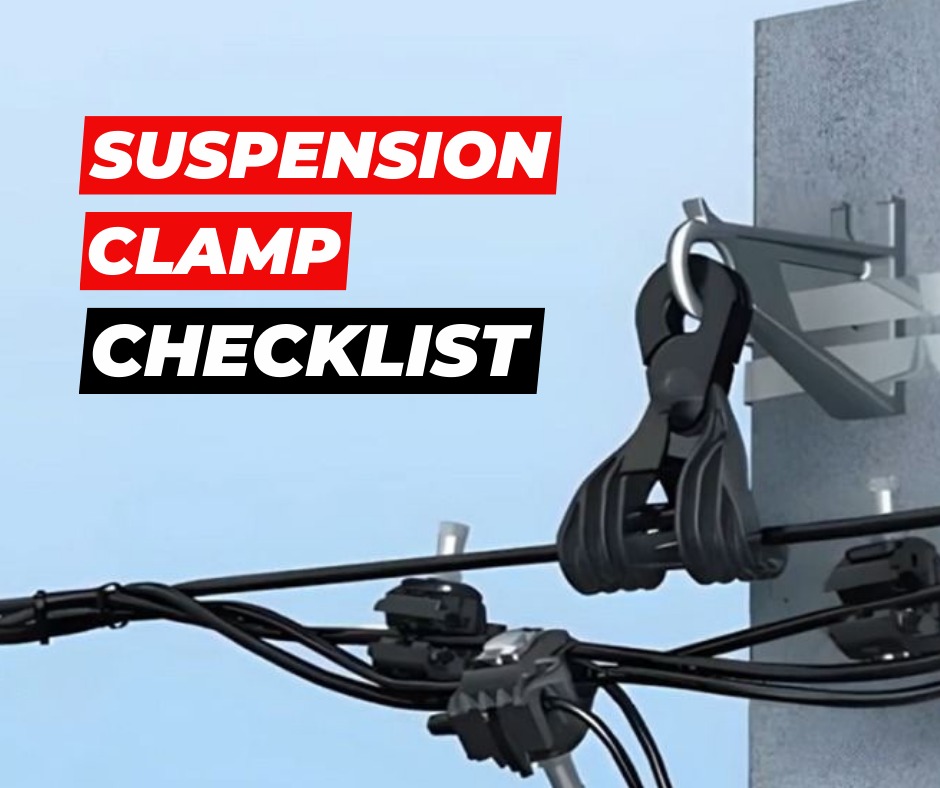
Suspension clamps are used to suspend and grip neutral messenger cables in Low Voltage Aerial Bundled Cable System. They hold cables in place without damaging the insulation. A suspension clamp attaches to a bracket to support the cable’s weight and keep it secure along the route.
Since suspension clamps carry the cable’s full load and protect its insulation, even a small installation mistake can lead to damage or failure. That’s why this installation checklist is important.
In today’s blog, we’ll walk you through a simple suspension clamp installation checklist to help ensure that your suspension clamps work reliably and your cables stay secure on site.
The Checklist
1. Product Specification and Performance Standard

Before you procure a suspension clamp, ensure it is tested as per NFC 33-040. Ask your supplier for the test certificates. This standard ensures the clamp meets safety and performance requirements for LV cable systems. All suspension clamps manufactured at Axis comply with NFC 33-040.
2. Proper Cable Selection

Different suspension clamps are designed for different cable sizes. Pick the clamp according to the cable size from the datasheet. Using a clamp of the wrong size will not grip the cable properly. Your clamp may slip or damage the cable insulation.
3. Installation Orientation


Do not install the suspension clamp upside down. Many installers make this mistake on site. When installed upside down, the clamp cannot grip the cable properly. The cable will slip under load. This can cause the cable to drop out from the clamp or sag unnaturally, creating a safety hazard. Always check the clamp orientation before tightening.
4. Use Only a Wooden Hammer or mallet

Do not use a metal hammer or any other tool to install the suspension clamp. Metal hammers can damage the clamp body and deform the plastic. A damaged clamp will not grip the cable securely, it will slip under load, causing it to drop or break.
Talk to our engineers!
5. Special Conditions


Different utilities across India use different cable types based on their requirements. Some utilities use bare messenger cables and need suspension clamps with a grit. Others use insulated cables and need clamps without a grit. For example, Jammu & Kashmir, Uttar Pradesh, and Chhattisgarh typically use bare messenger cables. Assam, West Bengal, and Kerala use insulated cables.
6. Engineering-Grade Plastic

Do not accept clamps made from random or low-quality plastic. Engineering-grade plastic is UV and weather-resistant, providing strength and durability. It can withstand extreme conditions without degrading. Low-quality plastic will crack and fail under stress. This compromises the clamp’s ability to grip the cable securely.
7. Locking


Proper locking is crucial. Some clamps have multiple threads that need to be tightened. Many installers only tighten a few threads and ignore the others. This is incorrect. When you don’t tighten all threads, the clamp does not grip uniformly. Hence, uneven pressure is applied to the cable. The cable will slip under load. Over time, this can cause the cable to drop or break.
8. Adequate Assembly

Use proper assembly like brackets and eyehooks. They must be rated for your cable’s weight and pulling force. This means they are tested and approved to safely support your cable. A weak or improper assembly cannot handle the load. Over time, the cable will sag or slip. In worst case, it can break under tension.
9. Installation Angle

Before installing the suspension clamp, check the angle at which the cable turns. At turning points, many installers use a single suspension clamp to save cost. Here, you need two anchoring clamps. If the cable has a sharp turning angle, you cannot use a single suspension clamp. A single clamp creates uneven load distribution. The clamp will again slip or fail under tension.
We hope you now have a clear understanding of what to check before buying and installing suspension clamps. If we have missed anything important, please share it in the comments section below.
At Axis, we are proud of our contribution to rural electrification projects across India, Africa and the globe. Axis products are critical to the success of government schemes like SAUBHAGYA and currently running RDSS as well, playing a key role in enhancing electrical infrastructure.
Thank you for reading and if you found this informative, then feel free to contact us to get a quote or to know more about our products; visit our product section at https://axis-india.com/products/


