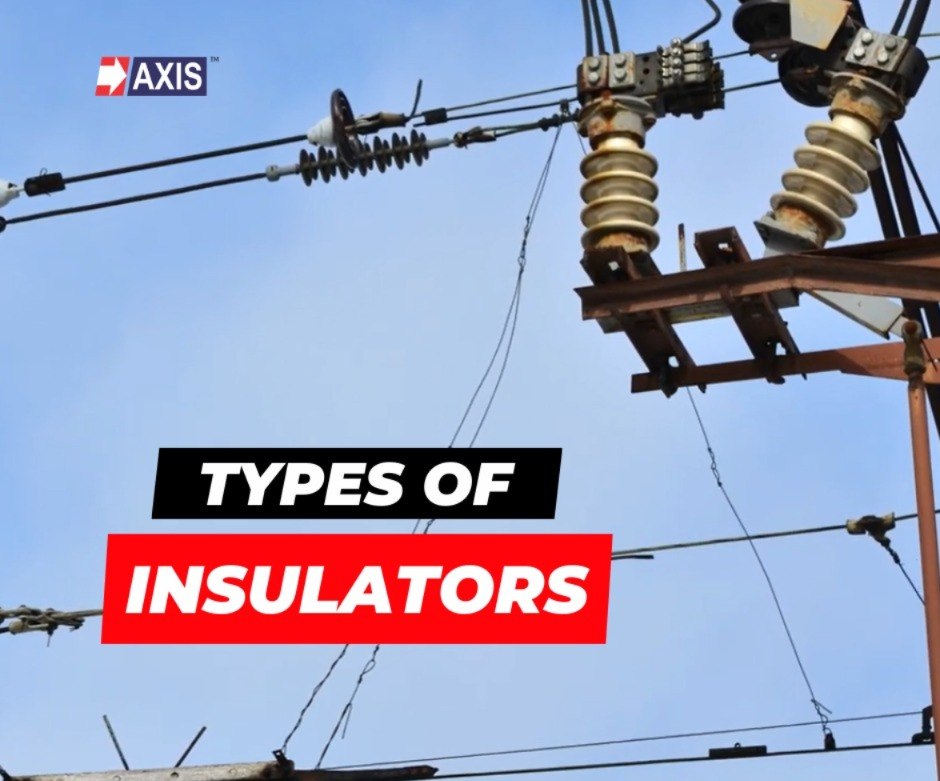
Insulators support and separate live conductors on transmission and distribution lines from the supporting metallic structure. Their main role is to stop current from leaking on to the pole, tower or the ground. They securely hold the conductor in position, even when the line faces wind, load changes or mechanical stress. There are various types of insulators because every line operates under different voltage levels, pollution conditions, environmental factors, and mechanical stresses.
In this blog, we will take a closer look at the different types of insulators used in transmission and distribution lines.
Pin Insulator
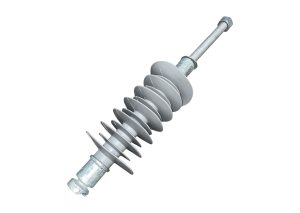
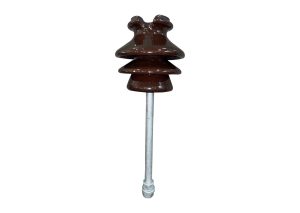
It has a threaded metal pin at the bottom that fixes it on the cross-arm, and the conductor rests on top. This design supports the line from above, and keeps your conductor electrically isolated from the pole.
Engineers use pin insulators where the electrical load and mechanical stress on the line are moderate. They are suitable for distribution voltages and for straight-line sections, where the conductor path does not change direction. You will see them on rural and semi urban feeders, small industrial networks and short pole spans.
The reason they work well in these areas is simple. Their design gives the insulation and mechanical strength needed for distribution networks. The structure is compact, easy to mount and quick to replace in the field. Pin insulators are available in ceramic and polymer versions. The choice depends on pollution level, site conditions and the required mechanical strength. At Axis, we manufacture and supply both polymer insulator and ceramic pin insulators.
Disc Insulator
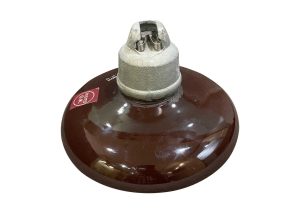
These insulators are installed at locations where the line experiences maximum pull. This includes angle points, dead-ends, river crossings and long spans. They protect your structure by absorbing the tension in the conductor, and preventing the load from transferring directly to the tower or pole.
The suspended design spreads the mechanical load across a chain of discs. This gives higher strength, greater flexibility and a longer creepage distance compared to pin or shackle insulators. As the voltage increases, the required mechanical strength and insulation level also rise, which makes disc insulators the preferred choice for transmission lines.
Talk to our engineers!
Stay Insulators
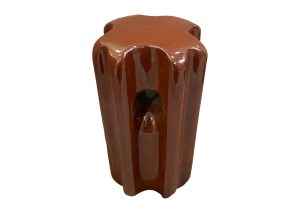
These insulators are used when a tower needs extra support. You will see them in areas with strong wind, uneven soil or long spans where the tower must stay steady. By isolating the guy wire, the insulator stops fault current from travelling down the wire into the ground. If this happens, the current will create dangerous touch and step potentials around the pole and nearby structures.
Also, guy wires carry mechanical tension and the risk of becoming a current path during faults. The stay insulator blocks that path, while still allowing the guy wire to support the tower. Its porcelain body handles the pull on the wire and provides the insulation needed to stop leakage current.
Shackle Insulators
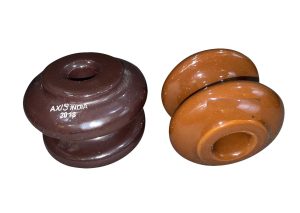
Engineers use a shackle insulator on low-voltage distribution lines to support the conductor over short distances. They mount it on the pole with a D-iron or bolt, and place the conductor in the groove of the insulator. This design keeps the wire insulated from the pole and allows the line to change direction safely.
These insulators are used on LV and small MV distribution networks where the conductor needs to take a small angle or pass around an obstacle. You will see them on service lines, short spans and dead-end points where the mechanical pull is moderate. They are easy to replace and can support your conductor horizontally and vertically, depending on the pole layout.
At higher voltages, the creepage distance becomes too short and the mechanical strength is not enough to handle the longer spans or higher tension. Therefore, medium and high voltage lines shift to pin, post, strain or disc insulators.
We hope you now have a brief idea about these insulators.
Note: There are many more, we have covered the prominent ones.
At Axis, our team of over 50 engineers are ready to assist you with designing, installing, and testing your Electrical Hardware. Clients worldwide trust and install our components in various settings, including substations, data centres, factories, and transmission and distribution towers.
Thank you for reading and if you found this informative, then feel free to contact us to get a quote or to know more about our products; visit our product section at https://axis-india.com/products/