Metal vs Non-Metallic Cable Glands
Classification by Electrical Role
Now that you understand cable glands based on material, let us look at their classification based on electrical role. This is important because it directly affects safety during faults.
From an electrical point of view, glands fall into two categories:
Cable glands that provide earthing continuity
Cable glands that provide electrical insulation
Earthing Continuity: Earthing continuity is the continuous electrical path that safely carries fault current to the ground. In simple terms, it ensures that if something goes wrong, the current has a safe path to earth.
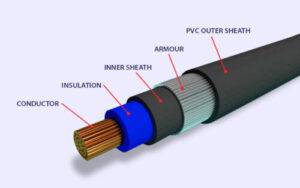
Cable glands that provide earthing continuity are usually made of metal. When installed correctly, they create a continuous electrical path between the cable, the gland, and the enclosure. This allows fault current to flow safely into earth during insulation failure. You will mainly see this in armoured cables, where the gland clamps the metal armour and transfers fault current to the enclosure. This reduces the risk of electric shock and improves system safety. Therefore, heavy industrial installations commonly use metal glands.
Electrical Insulation: Electrical insulation means stopping electricity from flowing to unwanted parts, so you and your equipment stay safe.
Cable glands that provide this insulation are non-metallic glands, usually made from PVC or other polymer materials. They do not conduct electricity and therefore do not provide an earthing path through the gland. In these cases, earthing is handled separately through the cable’s earthing conductor or through the system design. The gland’s role here is limited to sealing, strain relief, and insulation. These glands are commonly used in indoor electrical enclosures, where fault currents are low and mechanical stress is minimal.
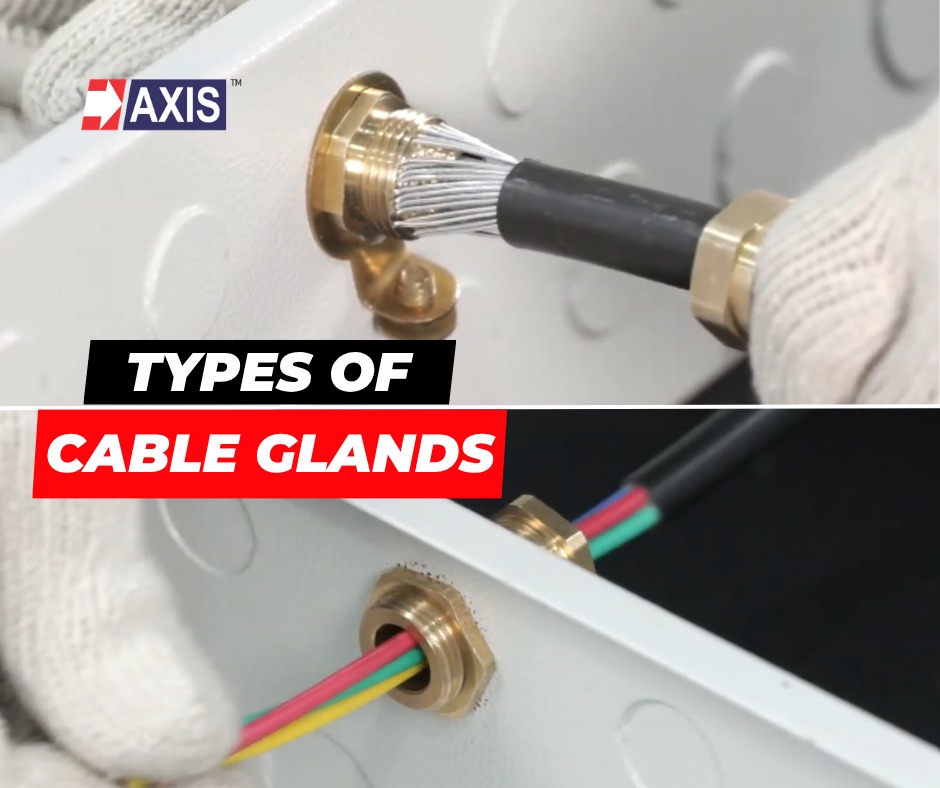
4 Types of Cable Glands
Now that you understand how cable glands differ by material and electrical role, let us look at the common types you will see in real installations.
1. Single Compression Cable Gland:
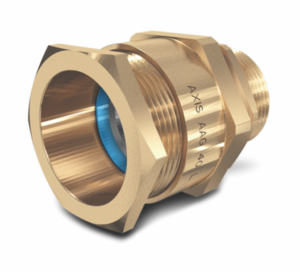
This type is used with armoured and unarmoured cables, where sealing is required only on the outer sheath. The gland grips and seals the cable at one point. You will find them in solar installations, rail signaling panels, data center control panels, and indoor electrical enclosures. A popular type includes the A1-A2 gland. This design works because unarmoured cables do not need armour clamping and only require proper sealing, basic strain relief, and safe earthing through the enclosure.
2. Double Compression Cable Gland:
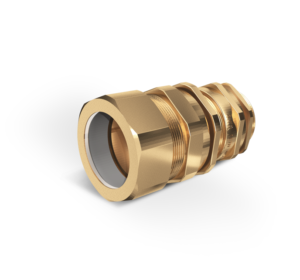
This gland grips the cable at two points. One seals the under-armour part of the cable, while the other seals the outer sheath. These glands are usually made from brass or nickel-plated brass. A common variant you may come across is the E1W gland. This design works because armoured cables require armour clamping for mechanical strength and earthing, along with proper sealing at the enclosure entry.
3. Flameproof (Explosion-Proof) Cable Gland:
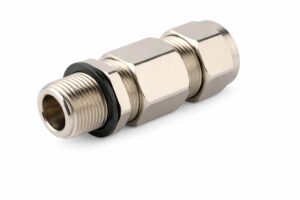
This gland is used in areas where there is a risk of fire or explosion due to the presence of flammable gases, vapors, or dust. These glands are designed to stop flames or hot gases from passing through the cable entry during a fault. They are usually made from metal to withstand high pressure and temperature. You will find them in hazardous industrial zones. Common variants include flameproof double compression glands and certified hazardous-area glands.
4. EMC / EMI Cable Gland:
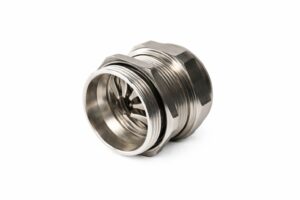
Used where electrical noise can affect equipment performance. These glands maintain electrical contact between the cable screen and the enclosure, controlling electromagnetic interference. They are usually made from metal to ensure proper shielding continuity. Shielding continuity means maintaining an unbroken electrical connection between the cable screen and the enclosure, so external electromagnetic interference does not affect the equipment. You will find these glands installed in rail signaling systems, control rooms, and automation panels, because sensitive electronic systems need continuous shielding to prevent signal disturbance and data errors.
We hope you now have a brief idea about these cable glands.
Note: There are many more types; we have covered the most prominent ones.
At Axis, our team of over 50 engineers are ready to assist you with designing, installing, and testing your Electrical Hardware. Clients worldwide trust and install our components in various settings, including substations, data centres, factories, and transmission and distribution towers.
Thank you for reading and if you found this informative, then feel free to contact us to get a quote or to know more about our products; visit our product section at https://axis-india.com/products/