Every year, thousands of people are injured or killed by lightning strikes. What many don’t realize is that most of these disasters are preventable.
In this blog, you will learn how to protect yourself from lighting strike as per IEC TR 62713.
What is IEC TR 62713?
This is an educational guide on lightning safety for the general public. It explains how to ensure safety during lightning and thunderstorms. It is designed for laypersons, not just technical experts. Its purpose is to help people understand lightning risks, take protective measures, and protect life and property during storms.
To help you understand this standard better, we will discuss:
- Effects of Lightning Strike
- Lightning Warning and Detection
- Lightning Strike Effects on Humans
- Safety Strategies by Locations
- First Aid and Treatment
Effects of Lightning Strikes
Lightning carries tens of thousands of volts and, can harm people and equipment in multiple ways. It combines electrical, magnetic, and mechanical forces in a single natural event. Let’s understand what happens in those few milliseconds when lightning makes contact, and how its physical and electrical effects cause damage.
At the strike point, temperatures can reach 30,000 Degrees Celsius – five times hotter than the sun’s surface. Heat radiates rapidly, making metallic objects deadly during storms.
Lightning current changes within microseconds, creating strong electrical and magnetic fields. These can damage nearby equipment, disturb communication lines, and in some cases, interfere with the human heartbeat.
But the danger is not only in the air. It is also on the ground, let’s discuss Ground-Related Hazards. Lightning can make the ground itself dangerous.
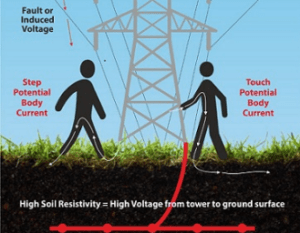
- If you touch a conductor while standing on the ground, the current travels through your body. This is Touch Potential.
- If your feet are apart, voltage differences between them drive current through your body. This is Step Potential. We have a separate video explaining Touch & Step Potential in detail. Link is in the description.
- If lightning current enters the ground, it spreads outward through the soil, creating voltage differences, this is Ground Potential Rise. When this happens, even standing a few metres from the strike can be dangerous. The current can travel through the soil and into your body, causing burns, muscle damage, or even cardiac arrest.
Now that you know how dangerous lightning can be, let us see how to identify when a storm is approaching. Because the best protection always starts with early warning.
Lightning Warning & Detection
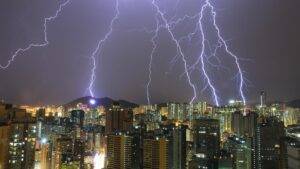
That is where warning systems help. Local weather stations issue alerts when there is a high chance of lightning, usually with about 20 to 30 minutes of warning. Industrial plants, airports, and large open areas can also install lightning warning systems, that monitor electrical conditions and provide real-time alerts before a strike.
Even without such systems, you can still stay informed. Most weather apps today provide live lightning notifications, helping you take cover before a storm hits.
There is also a simple DIY technique that anyone can use to estimate how far lightning is. When you see a flash, start counting the seconds until you hear thunder. Then divide that number by three. The result, gives you the approximate distance in kilometres.
For example, if you count six seconds between the flash and the thunder, the lightning is about two kilometres away. If the time between flash and thunder is less than ten seconds, the lightning is very close, and you should seek shelter immediately. If the time gap keeps getting shorter, it means the storm is moving towards you.
Talk to our engineers!
Lightning Strike Effects on Humans
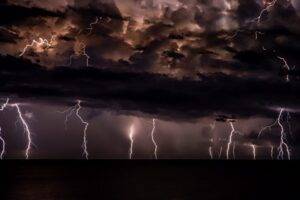
Lightning affects the human body instantly and severely. There are two main types of strikes – direct and side strikes.
A direct strike hits the body directly and can stop the heart or breathing within seconds, often leaving both internal and external burns. A side strike happens when lightning jumps from a nearby object to a person, usually hitting the head or shoulders. This is why you should never take shelter under trees or near tall structures.
Lightning can affect multiple parts of the body – the heart, brain, lungs, muscles, eyes, and skin. Quick medical help can save lives.
Safety Strategies by Location
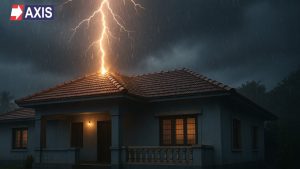
Next, safety strategies based on location, because what you should do during a thunderstorm depends on where you are at that moment.
If you are indoors:
- Close all doors and windows. Stay away from balconies and avoid standing near open areas.
- Do not touch plumbing lines, metal pipes, or electrical wiring.
- Avoid taking showers or washing dishes, since water conducts electricity.
- Unplug electronic devices because surges from nearby lightning can damage them.If you are outdoors:
- Avoid open areas, mountain slopes, beaches, and fields.
- Do not hold metal objects like umbrellas, golf clubs, or tools.
- Stay away from trees, poles, or tall isolated structures. Keep at least 10 metres from trees and a few metres from metallic structures.
- If you cannot find shelter, crouch down with your feet close together, and your head tucked in to reduce your contact with the ground.
- If you must move, shuffle or hop with your feet together to reduce step potential.
If you are in a vehicle:
- Metallic cars offer good protection because they act like a Faraday cage, as long as the windows are closed.
- Avoid touching metal parts inside the car.
- Drive carefully, because lightning can cause blinding flashes or loud sounds that affect concentration.
- Do not use convertibles or open-roof vehicles during storms.
- Vehicles may suffer tire damage or puncture from heat transfer.
If you are camping or in a tent:
- If there is no lightning-protected structure or metallic shelter available, stay inside the tent in a crouched position.
- Caravans and mobile homes with metallic bodies are as safe as cars, but those made of fiberglass or plastic do not offer protection.
- Avoid setting up tents or parking trailers on hilltops, open fields, or near the edges of forests.
- Keep at least three metres of distance between neighbouring tents or vehicles, and do not connect any metallic wires between them.
- Unplug all electrical cables and lower any external antennas before a storm begins.
If you are in the mountains:
- Stop climbing immediately when a storm starts.
- Move away from peaks, cliffs, ridges, or cracks.
- If you feel your hair standing or hear a buzzing sound, it means lightning is about to strike – crouch down immediately.
- Remove all metal gear such as jewellery, watches, or climbing tools from your body.
- Avoid touching rocks, metal ladders, or wet ropes.
If you are on or near water:
- Lightning can travel across the surface of water, so even a strike 100 metres away can be dangerous. At the first sign of thunder, leave the water and move to land.
- If you are on a boat, stop all activities and move below deck if possible.
- Stay away from metal parts and keep your feet close together.
- If you are diving, move to the surface only after the storm has passed – lightning can create shock waves strong enough to cause serious injury.
If you are at an open-air event or festival:
- Check the weather before attending.
- During a storm, avoid open stages, platforms, or metal barriers.
- Do not touch metal poles or fences and try to keep at least 1 to 3 meters from conductive surfaces.
- If lightning is close, move to a covered or lightning-protected structure if available.
If you are playing sports outdoors:
- Stop all games and move to a safe area as soon as lightning or thunder is seen or heard.
- Coaches and organisers must suspend activities immediately.
- Golf courses are especially dangerous because of open areas and metal equipment.
- If you cannot find a fully enclosed building or vehicle, stay near a group of small trees or structures, keeping at least 5 to 10 meters distance from others.
Lightning can strike anywhere and sometimes without warning. Even when you follow every safety rule, accidents can still happen. What matters then is how you respond in those first few minutes, because that is when lives can be saved.
First Aid & Treatment

Let us say someone is struck by lightning. Here is what you need to do. Lightning passes through the body very quickly, so revival is often possible if help is given immediately. But not all lightning injuries look the same. Some may appear mild, while others are life-threatening.
To understand how severe the damage may be, lightning injuries are divided into three levels.
First, mild injuries: The person may be awake but confused, unable to remember what happened, or feeling muscle pain and tingling. Take them to a hospital right away. Internal injuries can be hidden, and recovery takes time.
Next, moderate injuries: The person may have temporary paralysis, low blood pressure, burst eardrums, or burns. If they are not breathing, begin CPR immediately. Brain damage can occur within minutes without oxygen.
Lastly, severe injuries: These are life-threatening and often involve cardiac arrest or brain trauma. The victim may also be thrown by the shockwave. Call for medical help immediately.
Here’s a checklist of what you should do, no matter how serious the injury looks:
- Make sure the area is safe before helping. The person is not electrically charged, it is safe to touch them.
- Check if they respond when you call out or tap their shoulder.
- Call emergency services and share your exact location.
- If they are not breathing, start CPR right away: 30 chest compressions and 2 rescue breaths. Keep going until help arrives.
- If they are breathing but unconscious, place them on their side to keep their airway open.
- Cover burns with a clean, dry cloth. Do not use ice or water.
- Keep checking their pulse and breathing. Conditions can change fast.
Even if the person seems fine, they must go to a hospital. Internal damage may not show immediately, and timely medical care can prevent serious complications.
We hope you now have a clear idea of how to protect yourself from lighting strike. At Axis, we have a team of 50+ engineers who design, install, and test Earthing and Lightning Protection Systems as per these standards.
Our products have been used in substations, data centres, factories, and even in everyday residential and commercial buildings.
Thank you for reading and if you found this informative, then feel free to contact us to get a quote or to know more about our products; visit our product section at https://axis-india.com/products/ Follow us on LinkedIn for regular updates on our Products!