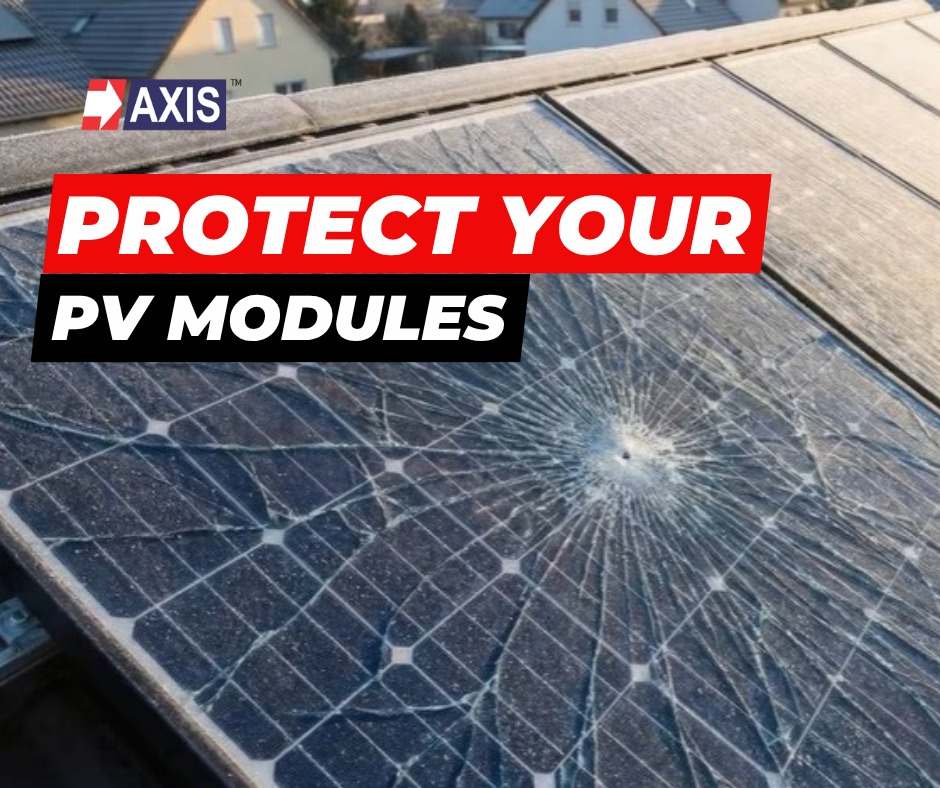
Your PV modules are the most exposed and most critical part of your solar plant. In a utility-scale project, modules alone can contribute around 40% to 50% of the total project cost. They operate outdoors for approximately 25 years, exposed to heat, lightning, and electrical stress. If modules fail, generation drops immediately, and replacing them is not just about component cost. It involves labour, downtime, and performance loss. Understanding how lightning affects your PV modules is not optional.
Following are the specific points where lightning can cause damage in your PV modules and connected equipment.
1. Bypass Diode Failure
Every PV module contains bypass diodes. They protect the cells during partial shading by allowing current to flow around shaded sections. Under normal operation, they handle limited current.
During a nearby lightning event, high surge currents can enter the DC string. These surge currents can exceed the rated capacity of the bypass diode. When that happens, the diode fails. Once it fails, the affected cell string cannot regulate current properly. Local heating starts, hotspots develop, and over time, module performance reduces while internal damage progresses silently. Your module may continue to operate, but its output reduces and degradation accelerates.
2. Inverter Damage
The inverter is the brain of your solar plant. It converts DC power into usable AC power, but it is directly connected to long DC cables. During a lightning event, surge voltage travels along these cables. If this surge is not diverted through a proper protection system, it reaches the inverter input.
The inverter contains sensitive components such as control boards, gate drivers, capacitors, and IGBTs. These components are not designed to handle high impulse voltage. When surge voltage exceeds their limit, components fail, the inverter trips, and in many cases, internal boards need replacement. This results in immediate generation loss, and inverter downtime directly affects plant revenue.
3. Glass Fracture due to Thermal Shock
A lightning strike creates an extremely fast rise in temperature, with energy released in microseconds. Even if the strike is nearby and not direct, the electromagnetic effect can cause rapid heating in exposed metallic structures and module surfaces.
Glass expands when heated. If the temperature change happens too fast, the glass does not expand uniformly, which creates internal stress. When the stress exceeds the mechanical strength of the glass, micro cracks form. These cracks may not be visible from a distance, but once they develop, moisture enters the module. Moisture reduces insulation resistance and increases the risk of leakage current and long-term failure. So even without a direct strike on the panel, lightning can create structural damage that will reduce module life.
Talk to our engineers!
4. Back Sheet Delamination and Insulation Breakdown
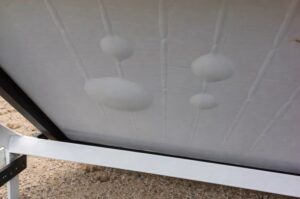
The back sheet of a PV module acts as an electrical insulator. It protects the internal cells from moisture and environmental exposure. During a lightning event, high voltage surges can appear across the module structure, creating electrical stress across the insulation layers.
If the voltage exceeds the insulation strength, partial breakdown begins. Over time, this weakens the bond between layers of the back sheet, leading to delamination. Once delamination starts, the protective barrier is compromised. Moisture and dust enter the module, and current leakage increases. This type of damage may not cause immediate failure, but it shortens the operational life of your module significantly.
5. Frame to Cell Flashover
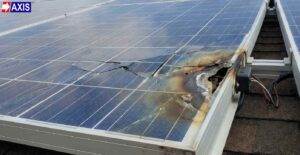
Every PV module has an aluminium frame connected to the mounting structure. Inside the module, the solar cells operate at DC voltage. During a lightning event, a large potential difference can develop between the frame and the internal cell circuit. This voltage difference can reach 2 to 3 kilovolts or even higher depending on the surge level.
If the insulation gap inside the module cannot withstand this voltage, an arc will jump from the frame to the cell circuit. This is called flashover. When flashover happens, it burns the conductive tracks inside the module and damages cells permanently. In some cases, it creates carbonised paths that continue to cause leakage. Unlike gradual degradation, flashover is sudden and destructive, causing immediate output drop. Critically, this can happen even without a direct lightning strike on the module. A nearby strike can create enough voltage difference to trigger this event.
6. String Combiner Box Damage
The string combiner box collects DC current from multiple module strings and sends it to the inverter. It contains fuses, busbars, terminals, and Surge Protection Devices. During a lightning event, surge voltage enters through the DC strings, making the combiner box one of the first concentration points of this energy.
If Surge Protection Devices are not properly selected or coordinated, they fail. When an SPD fails under high surge, it can cause internal damage, leading to overheating of busbars. In some cases, internal wiring burns and terminal blocks loosen due to thermal stress, requiring full replacement of the combiner box. Since the combiner box connects multiple strings, failure here affects a large section of the plant, even when no direct strike has reached the modules themselves.
The Solution: A Properly Designed Lightning Protection System
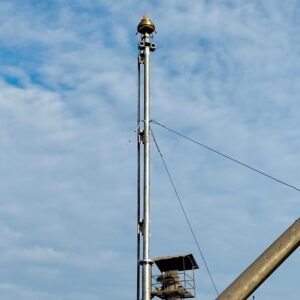
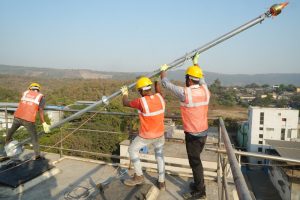
All of this damage happens when lightning energy is allowed to travel through your equipment. A properly designed Lightning Protection System prevents this by giving lightning a controlled path to the ground. Air terminals intercept the strike. Down conductors carry the current safely. A low-resistance earthing system dissipates the energy into the soil. Surge Protection Devices limit overvoltage on DC, AC, and communication lines.
When these systems are designed correctly, surge energy does not pass through your modules, inverter, combiner box, or BESS. It is diverted safely away from your critical equipment. Please note, the design and protection measures should only be carried out by a competent or authorised engineer.
We hope you now have a clear understanding of how lightning can affect your PV modules and why a properly designed Lightning Protection System is critical for your solar projects.
At Axis, we have been manufacturing a wide range of Lugs & Connectors, Earthing and Lightning Protection Solutions for more than 30 years. Our products are installed in solar plants, utility-scale applications, substations, control panels, switchgears, and many more. We have a team of 50+ engineers ready to help you in designing, installing, and testing your Lightning Protection Systems.
Thank you for reading and if you found this informative, then feel free to contact us to get a quote or to know more about our products; visit our product section at https://axis-india.com/products/