
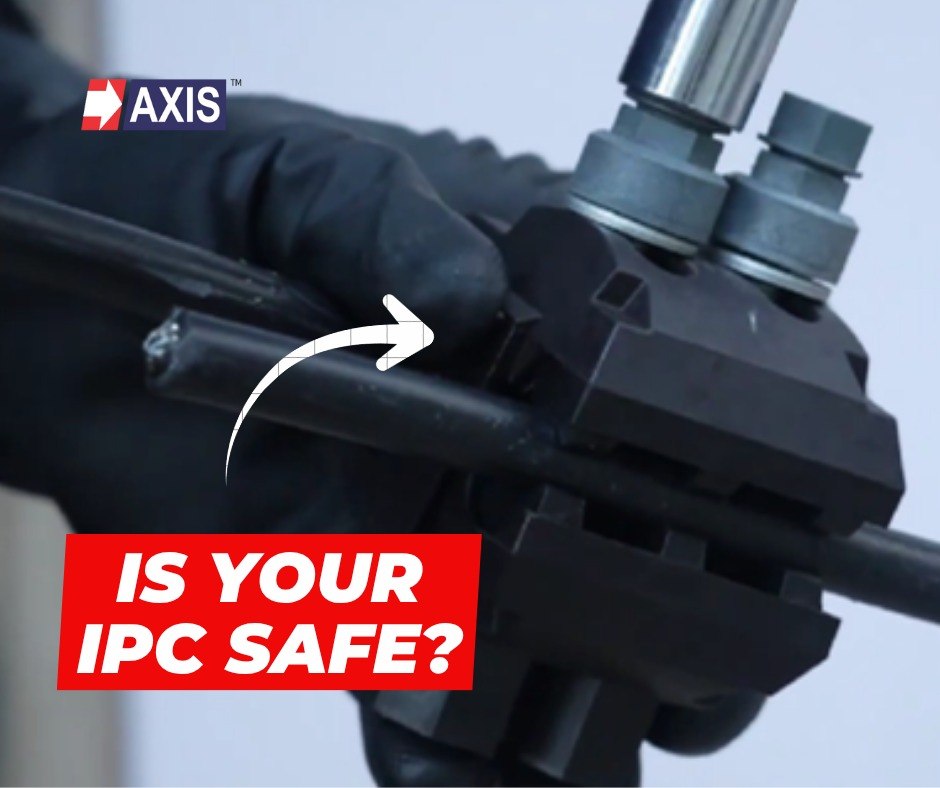
You are working on a live line and taking a connection using an Insulation Piercing Connector (IPC). Why does this not electrocute you? The answer lies in four things: the product design, testing, installation, and application. Let us break each one down.
What is an Insulation Piercing Connector?
An Insulation Piercing Connector (IPC) is used to connect a branch cable to a main conductor without removing insulation. At Axis, we manufacture two types of IPCs: low voltage IPCs for Aerial Bundled Cables and medium voltage IPCs for Covered Conductor Systems. These connectors are used in overhead distribution networks for street lighting and service connections, where utilities often carry out installation without shutting down the line.
So the question is valid: you are piercing a live cable, so how is it safe?
1. Product Design
The connector body is made of insulating material, so there is no direct access to any live part. The metal teeth that pierce the insulation are enclosed inside the connector, it only makes contact with the conductor when the bolt is tightened. The tightening bolt is designed such that no live conductive parts are exposed to the installer, which means you do not come in contact with any type of live conductor during installation.
2. High Voltage Testing

Design alone is not enough. You need to verify it through testing. The high voltage test checks whether the insulation can withstand electrical stress, especially during fault conditions. As per NFC 33 020, the connector must hold a specified high voltage for a defined time without breakdown. In this test, if the HV tester trips before the required time, the sample has failed, meaning the IPC could not sustain the required high voltage level. For Axis IPCs, the tester does not trip and the connector holds 6 kV for 60 seconds. This confirms that the insulation meets dielectric requirements under specified test conditions.
Talk to our engineers!
3. Correct Installation
Even a well-designed and well-tested product can become unsafe if it is installed incorrectly. There are a few critical steps to follow. You must use insulated tools specifically designed for live working. The installation should be done under an offload condition, where the main line is live but the branch cable is still de-energised at the moment of connection. The branch cable must first be inserted into the connector, and the exposed end of the branch cable must be sealed using an insulated cap. If this step is skipped, it leaves a live conductor exposed, creating a direct safety hazard.
4. Right Application
IPCs are designed for overhead distribution networks such as aerial bundled cables, covered conductors, and street lighting connections. They are not intended for indoor wiring or meter connections. In indoor or metered applications, tightening the IPC applies rotational and pulling forces on the conductor, which disturbs existing terminations at the meter or distribution board. This leads to loose connections, overheating, and long-term reliability issues. Using the right connector in the right application is just as important as correct installation.
Are IPCs Safe for Live Line Working?
Yes, they are safe when all four conditions are met:
- Your IPC is properly tested
- You use the correct insulated tools
- You follow the right installation process
- You use the connector in the right application
- You adhere to approved live-line working practices
We hope you now have a clear understanding of how IPCs work on live lines and what makes them safe in real installations. At Axis, we have been manufacturing a wide range of AB Cable Accessories including IPCs for the past 30 years.
In 2025, we manufactured and supplied more than 15 million Insulation Piercing Connectors, trusted by more than 80 utilities across India, Africa, and Latin America. Our team of 50+ engineers is ready to support your project needs for AB Cable Accessories, Lugs and Connectors, Earthing and Lightning Protection, and many more.
Thank you for reading and if you found this informative, then feel free to contact us to get a quote or to know more about our products; visit our product section at https://axis-india.com/products/