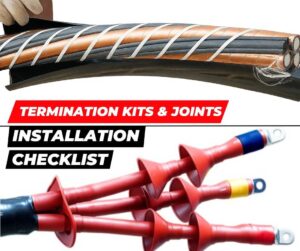
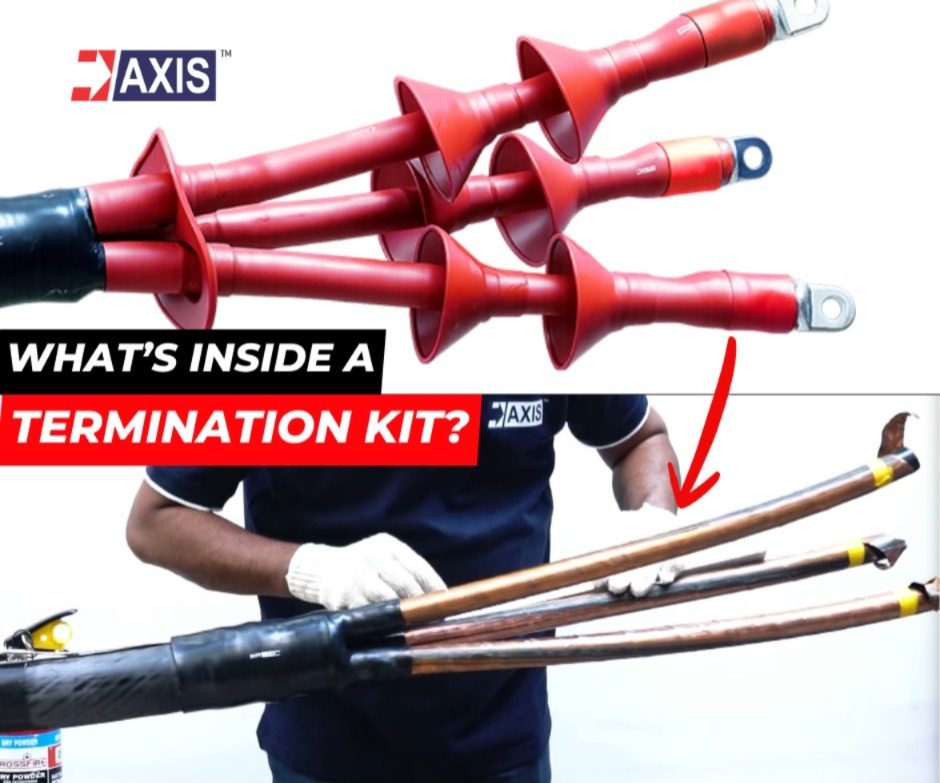
In today’s blog, we will discuss the key components inside a heat shrink termination kit.
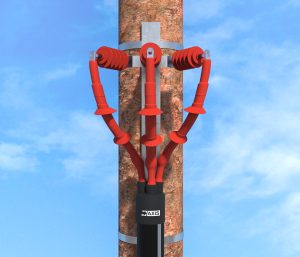
Components of a Termination Kit
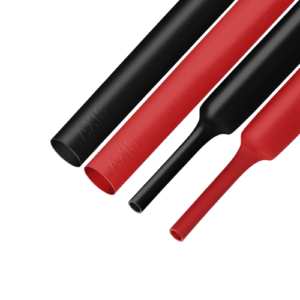
1. Anti-Tracking Insulation Tube.

This tube is made from cross-linked polyolefin, with resistance to tracking and erosion. It protects the termination surface from leakage currents caused by moisture, dust, and pollution. By forming a durable outer insulation layer, it also prevents surface discharge and flashover.
2. Stress Control Tube.

Made from a specially formulated cross-linked polyolefin with stress controlling properties. Its role is to manage and redistribute electrical stress. This is especially important at the semi-conductive screen cut area of the cable, where stress concentration is highest. When heated, the tube shrinks over the insulation screen transition and smooths the electrical field. This reduces the risk of partial discharge, and premature insulation failure, ensuring long-term reliability of the termination.
3. Rain Sheds.
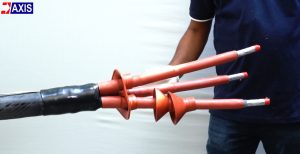
Rain sheds are used to increase creepage distance and control surface leakage currents. For 11 kV terminations, rain sheds are used only in outdoor installations. For higher voltage terminations, rain sheds are used in both indoor and outdoor applications to improve insulation performance and reduce the risk of tracking and flashover.
4. Breakouts.
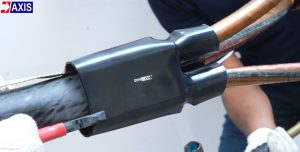
Breakouts are used to seal and insulate individual cores in multi-core cable terminations. They prevent moisture, dust, and contaminants from entering the cable at the core separation point. Breakouts are used in both indoor and outdoor terminations to maintain insulation integrity and ensure long-term reliability.
Talk to our engineers!
5. Cable Lug.
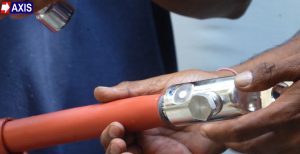
This cable lug provides the mechanical and electrical connection between the cable conductor and the equipment terminal. It ensures efficient current transfer while maintaining a secure, low-resistance joint. Proper selection and crimping of the lug are critical, as poor connections will lead to overheating, voltage drop, and eventual termination failure.
6. Stress Control Mastic.

Also known as yellow mastic, it is used to control electrical stress at critical points within the termination. It is applied around the insulation screen cut-back area, where sharp edges or uneven transitions can cause stress concentration.
When wrapped and pressed into place, the mastic fills gaps and smooths out irregular profiles on the cable surface. This helps in creating a gradual electrical field transition, instead of an abrupt change. By doing this, it reduces localized electrical stress and lowers the risk of partial discharge at the termination interface.
7. Sealing Mastic.

These mastics are used to block gaps and seal interfaces within the termination. They prevent the ingress of moisture, dust, and contaminants that can compromise insulation performance over time. By creating a continuous and sealed profile, sealing mastics help maintain electrical integrity and protect your termination from environmental degradation.
8. Filling Mastics.

Filling mastics are used to smooth out irregular surfaces and eliminate voids within the termination build-up. They help create a uniform insulation profile, which is essential for even electrical stress distribution. By removing air pockets and sharp transitions, filling mastics reduce the risk of partial discharge and improve the long-term reliability of your termination.
9. Copper Braids.

Copper braids are used to provide a reliable earthing connection in the termination. They connect the cable screen or armour to the earth, allowing fault current to flow safely. Copper braids are used in both indoor and outdoor terminations, especially where proper earthing is critical.
We hope you now have a clear understanding of what components should be inside your termination kit. Always ensure that the selection and installation of heat shrink components are carried out by trained and authorized professionals.
At Axis, we have a team of over 50 engineers who can help you with choosing, applying, and testing heat shrink solutions. Our products are installed worldwide in solar farms, substations, data centres, factories, and in everyday residential and commercial projects.
Thank you for reading and if you found this informative, then feel free to contact us to get a quote or to know more about our products; visit our product section at https://axis-india.com/products/ Follow us on LinkedIn for regular updates on our Products!