
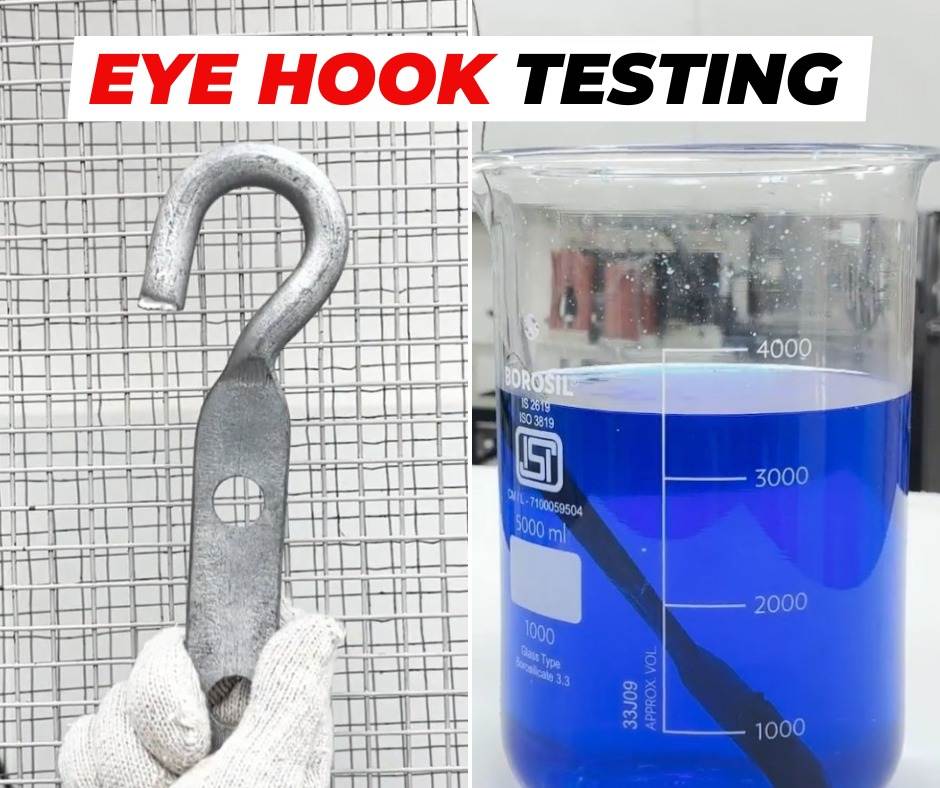
Eye hooks are critical fittings used with dead-end and suspension clamps to support
Aerial Bundled Cable lines.
They carry both mechanical load and environmental stress, so every piece must be tested before installation.

Eye hooks hold the entire weight and tension of the cable during and after installation. If one fails, the line can drop or break, creating serious safety risks.
The Tensile Test ensures the hook can handle this load without bending or breaking, while the Galvanizing Test ensures long-term corrosion resistance.

In this blog, you will learn how to perform the Tensile and Galvanizing Tests on eye hooks:
Mechanical (Load) Test as per IS 2486 Part 1 and REC-35, and Galvanizing Test as per IS 2633.
Note: Use proper tools, procedures, and PPE to avoid injury.
Tensile Test
Step 1: Mount the eye hook in the tensile testing machine with the load aligned to the hook axis.

Step 2: Apply the load gradually up to 2000 kg and hold for 1 minute. The hook passes if no deformation or cracks occur.

The Axis eye hook successfully passed the test without any visible damage.

Talk to our engineers!
Galvanizing Test
Step 1: Take a clean sample free from grease or paint and bring it to room temperature.

Step 2: Prepare solution as per IS 2633 (specific gravity 1.186 ±2°C) and immerse the sample for 1 minute.


Step 3: Rinse in clean water, wipe dry, and repeat for 4 dips.
Step 4: The test passes if no red copper deposit appears after final cleaning.
This confirms that the galvanizing is continuous and durable, ensuring long-term corrosion resistance.
You now understand how to perform both tests. At Axis, every eye hook is tested in a NABL-accredited lab to ensure quality and reliability.
Thank you for reading. If you found this helpful, feel free to share!