
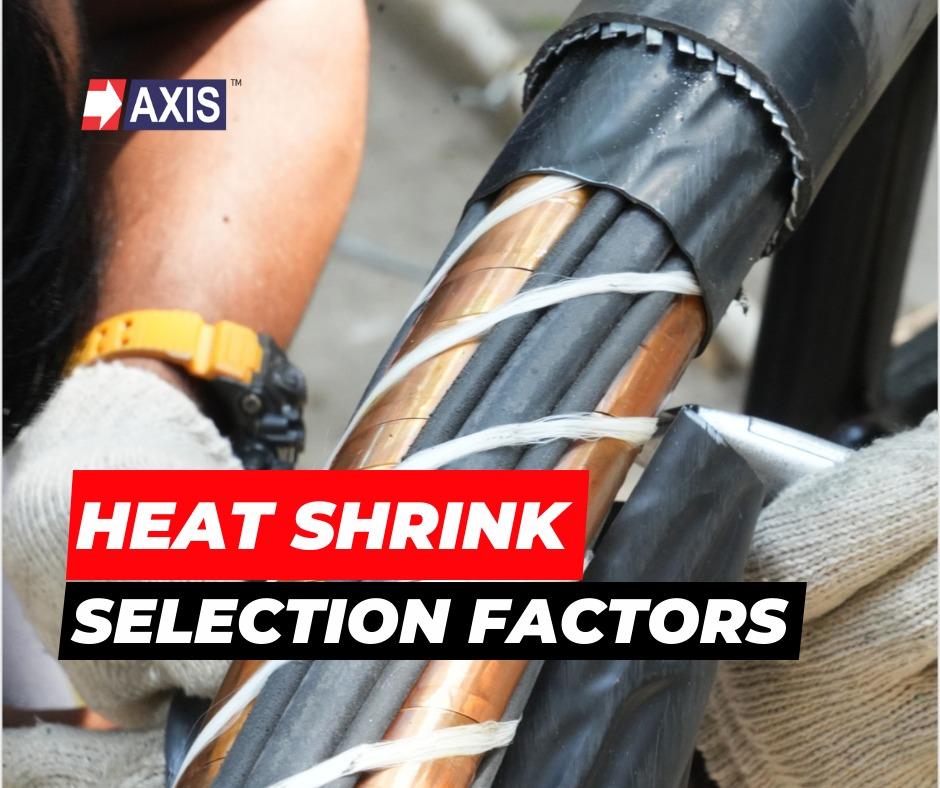
Heat shrinkable products are polymer components that shrink when you apply heat. During manufacturing, we expand them, but when you heat them at site, they return to their original size and grip the cable tightly.
In today’s blog, we will discuss the key factors you must consider while selecting heat shrinkable products.
Heat shrinkable products are used for insulation, sealing, and mechanical protection.
In practical applications, this includes heat shrink tubing, termination kits, straight through jointing kits, end caps, breakouts and many more.
Factors for selecting Heat Shrinkable Products
1. Voltage.

Before you select any heat shrinkable product, you must ask one question. What is my system voltage? Is it low, medium, or high?
In the case of power cables, low voltage usually means up to 1.1 kilovolt. Medium voltage typically ranges up to 36 kilovolts, and high voltage includes anything above 36 kilovolts.
Your voltage level decides your insulation requirement. If you are working in low voltage, the electrical stress on insulation is lower. In medium and high voltage, it increases. The higher the voltage, the higher the stress on the insulation surface. Hence, you cannot use the same tubing or kit across all voltage levels.
Then, you should check the wall thickness of the material. Wall thickness means the thickness of the heat shrink after it fully shrinks on the cable. It directly affects how much insulation distance you get between the live conductor and the outer surface.
If the thickness is too low for your voltage level, the electrical stress becomes high across a small insulation distance. The material won’t withstand that stress, leading to cracks in the insulation. This will lead to partial discharge, flashover, or complete failure.
Next, check the dielectric strength of the material. Dielectric strength means how much voltage the material can withstand before it breaks down. It is usually measured in kilovolt per millimetre. If the dielectric strength is lower than your system requirement, the insulation can puncture. Current can pass through the material, leading to short circuit, flashover, or complete failure.
2. Environment.
First, identify where you will use the product. Is it indoor or outdoor?
Indoor installations usually face stable temperature and limited exposure. Outdoor installations face sunlight, rain, dust, and pollution. You cannot use the same product in both cases without checking its rating.
Next, check UV exposure. Continuous sunlight can degrade many polymers. If the material is not UV stabilized, it can crack over time. Cracks allow moisture entry and reduce insulation life.
Now, the temperature range. What is the minimum and maximum level at site? The material must withstand operating and ambient temperature. If the heat exceeds the rating, the material will soften, deform, or lose insulation strength.
Next, evaluate humidity and condensation. In humid areas, moisture can enter small gaps. If sealing is poor, this can lead to corrosion and leakage current. Lastly, don’t forget to check pollution and dust levels. In industrial or coastal areas, contamination can settle on the surface. If there is voltage stress, this can lead to surface tracking.
Talk to our engineers!
3. Chemical and Industrial Exposure.
Will your product come in contact with oil, fuel, or industrial chemicals? Some materials swell or degrade in such chemicals. When that happens, they lose grip and sealing strength. If the installation is near coastal areas, salt fog will accelerate corrosion and create a conductive layer on the surface. This increases the risk of tracking under voltage.
Also check if flame retardancy is required. In areas with high electrical load, the material must resist the spread of flame. If it can’t, it will support combustion and allow fire to spread along the cable.
So, you must select the material based on the actual chemical and fire exposure at site, because polyolefin, PVC, fluoropolymers, silicone, and viton all behave differently under chemical stress and flame conditions.
4. Mechanical Stress.

Will your cable face abrasion or impact? If the tubing is rubbed against sharp edges or rough surfaces, thin material will wear out. Once the outer layer wears out, insulation reduces and the cable becomes exposed.
Is the installation subject to vibration? Continuous vibration can loosen tubing. Over time, this will create gaps and reduce sealing performance. Also, check if strain relief is required. At jointing points, the cable may experience pulling force. If the tubing cannot support that load, the joint will weaken.
Therefore, you must select the right wall type and mechanical strength based on the installation condition.
5. Shrink Ratio.

This ratio tells you how much the tubing will reduce in diameter after heating. For example, if you take a 20 mm tube with a 2:1 ratio, it will shrink down to about 10 mm. Similarly, a 3:1 ratio means it will shrink to one third of its expanded size.
This is important because in real installations, your cable will not have the same diameter everywhere. You will have lugs, connectors, or joints where the diameter will increase. The tubing must pass over the largest part and then shrink tightly over the smallest one.
Some common shrink ratios are 2:1, 3:1, and 4:1. These ratios affect installation ease and long-term reliability. We have a detailed video explaining the role of shrink ratios in depth. You will find the link in the description below.
We hope you now have a clear understanding of the factors that affect your heat shrinkable products.
Always ensure that the selection and installation of heat shrink components are carried out by trained and authorized professionals. At Axis, we have a team of over 50 engineers who can help you with choosing, applying, and testing heat shrink solutions.
Our products are installed worldwide in solar farms, substations, data centres, factories, and in everyday residential and commercial projects.
Thank you for reading and if you found this informative, then feel free to contact us to get a quote or to know more about our products; visit our product section at https://axis-india.com/products/