
AB Cable Accessories

How Safe Is Your Distribution Box? Critical Tests Explained!


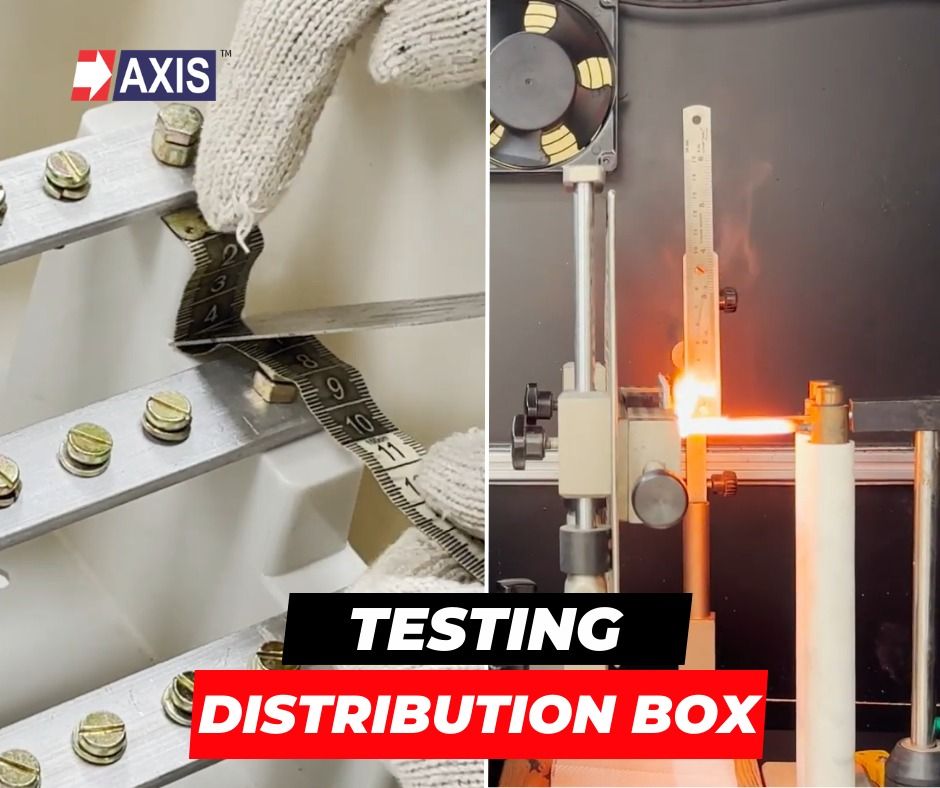
A Distribution Box contains live electrical components and must provide insulation and protection during normal operation and fault conditions. These tests ensure electrical safety and reliable performance of your distribution box under real service conditions.

In this blog, you will learn how to perform two important tests on a Distribution Box

  • The Creepage Distance Measurement Test
  • The Resistance to Abnormal Heat and Fire Test

Creepage Distance Measurement

This test verifies that the minimum creepage distances between live parts, metal parts, and mounting surfaces meet the requirements specified in the standard.

Step 1: Identify the Rated Voltage

Step 1: Identify the Rated Voltage

Determine the rated voltage of the assembly being tested. For this Axis 3-Phase DB Box, the rated voltage is 415 V.

Step 2: Measure the Creepage Distance

Step 2: Measure the Creepage Distance

Measure the shortest path along the surface of the insulating material, using a suitable measuring tool. Follow the surface contour and do not measure through air.

Step 3: Calculate and Verify Compliance

Step 3: Calculate and Verify Compliance

Refer to this creepage distance table in the standard. For 415 V, the minimum required creepage distance is 4 mm. The distribution box passes if the measured creepage distance is equal to or greater than 4 mm.

Talk to our engineers!

Resistance to Abnormal Heat and Fire

This test checks how the insulating parts behave under abnormal heat and fire conditions.

Step 1: Prepare the Test Sample

Step 1: Prepare the Test Sample

Select the insulating part of the distribution box that is exposed to thermal stress during a fault. Switch on the machine and insert the sample securely in the glow-wire test machine.

Step 2: Apply the Glow Wire

Step 2: Apply the Glow Wire

Heat the glow wire to the specified test temperature as defined in the standard. Apply the heated glow wire to the insulating surface for the specified duration.

Step 3: Verify Test Result

Step 3: Verify Test Result

The distribution box passes if there is no sustained flame, any flame extinguishes within the specified time, and there is no ignition of surrounding materials or loss of safety function.

We hope you now have a clear understanding of how to test your Distribution Box. This test is performed at our Axiom Lab in Mumbai, which is accredited by the National Accreditation Board for Testing and Calibration Laboratories (NABL) for ISO 17025-2017 and approved by Underwriters Laboratory (UL).

Thank you for reading and if you found this informative, then feel free to contact us to get a quote or to know more about our products; visit our product section at
https://axis-india.com/products/

Follow us on LinkedIn for regular updates on our Products!


Heat the glow wire to the specified test temperature as defined in the standard. Apply the heated glow wire to the insulating surface for the specified duration.


Step 3: Verify Test Result

The distribution box passes if there is no sustained flame, any flame extinguishes within the specified time, and there is no ignition of surrounding materials or loss of safety function.


We hope you now have a clear understanding of how to test your Distribution Box. This test is performed at our in Mumbai, which is accredited by the National Accreditation Board for Testing and Calibration Laboratories (NABL) for ISO 17025-2017 and approved by Underwriters Laboratory (UL).


Axiom Lab
Thank you for reading and if you found this informative, then feel free to contact us to get a quote or to know more about our products; visit our product section at https://axis-india.com/products/ 


Follow us on LinkedIn for regular updates on our Products!

Editor_account

Recent Posts

How to Test Split Bolt Connectors as per UL?

Split bolt connectors join conductors and carry current through the connection point. If the joint…

2 months ago

Is Your Insulation Piercing Connector Safe for Live Line Working?

You are working on a live line and taking a connection using an Insulation Piercing…

3 months ago

Are your PV Modules Safe from a Lightning Strike?

Your PV modules are the most exposed and most critical part of your solar plant.…

3 months ago

Key Steps in Designing an ESE Lightning Protection System

An Early Streamer Emission Lightning Arrester, this technology offers safety from direct lightning strikes. The…

3 months ago

Choose the Right Cable Gland For Your Project – Types Explained!

Have you ever noticed how cables safely enter and exit electrical enclosures? This is made…

4 months ago

Selecting Heat Shrink Products? 5 Key Factors You Should Know

Heat shrinkable products are polymer components that shrink when you apply heat. During manufacturing, we…

5 months ago