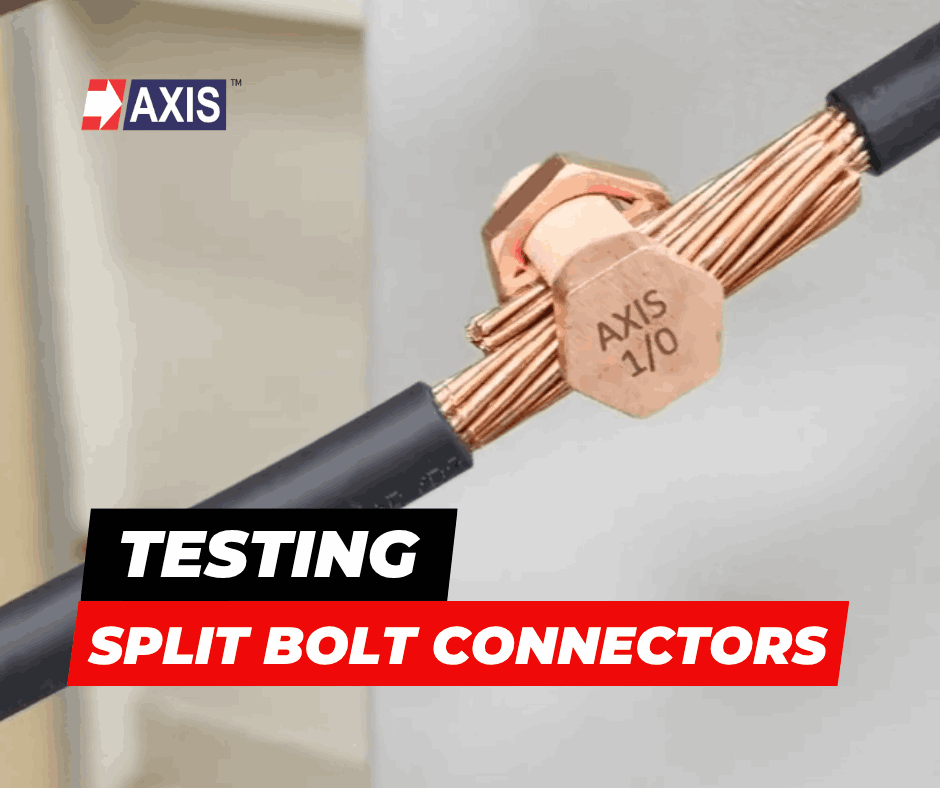
Split bolt connectors join conductors and carry current through the connection point. If the joint heats up, loosens, or fails under load, the entire system can fail. These tests check if the connector can handle current, hold the conductor tight, and stay secure during service.
In this blog, you will learn how to perform three important tests as per UL 486 A and B on split bolt connectors
Note: Always use the correct conductor size, torque, and test setup as per the standard.
This test checks how the connector behaves when current flows through it for a long time. The goal is to ensure the temperature rise stays within limits.
Step 1. Prepare the test sample using the specified conductor size. Install the split bolt connector as per the manufacturer’s recommended tightening method.
Step 2. Connect the test assembly to current injection source and pass the rated current based on the conductor size as defined in the standard.
Step 3. Continue the current flow until the temperature reaches a stable value. Measure the temperature of the connector.
Step 4. The conductor size being tested until stable temperatures are reached without exceeding a 50 °C temperature rise above ambient temperature.
The connector passes the static heating test if the temperature becomes stable and the temperature rise does not exceed 50°C above ambient. After this test, the same connector is subjected to the secureness test and the pull-out test.
This test checks if the connector holds the conductor firmly after installation.
Step 1. Fix the test assembly on the secureness test setup. Pass the other end of the conductor through the bushing and apply the specified weight as per UL standard.
Step 2. Rotate the assembly for 30 minutes.
The connector passes if the conductor does not slip, loosen, or move from its position. This shows the connection will remain tight during service.
As a result of the tests, there shall be no breakage of the conductor or any strand of a stranded conductor or other damage to the connector.
This test checks how much force the connection can withstand before the conductor pulls out.
Step 1. Fix the sample in the testing machine and apply a pulling force on the conductor.
The connector passes if the conductor does not pull out before reaching the minimum force defined in the UL standard.
We hope you now have a clear understanding of how to test split bolt connectors. These tests confirm that your connector can carry current safely, stay tight, and hold the conductor under load.
Thank you for reading and if you found this informative, then feel free to contact us to get a quote or to know more about our products; visit our product section at https://axis-india.com/products/
You are working on a live line and taking a connection using an Insulation Piercing…
Your PV modules are the most exposed and most critical part of your solar plant.…
An Early Streamer Emission Lightning Arrester, this technology offers safety from direct lightning strikes. The…
Have you ever noticed how cables safely enter and exit electrical enclosures? This is made…
Heat shrinkable products are polymer components that shrink when you apply heat. During manufacturing, we…
A Termination Kit is used to safely connect a cable to equipment like switchgear, transformers,…