
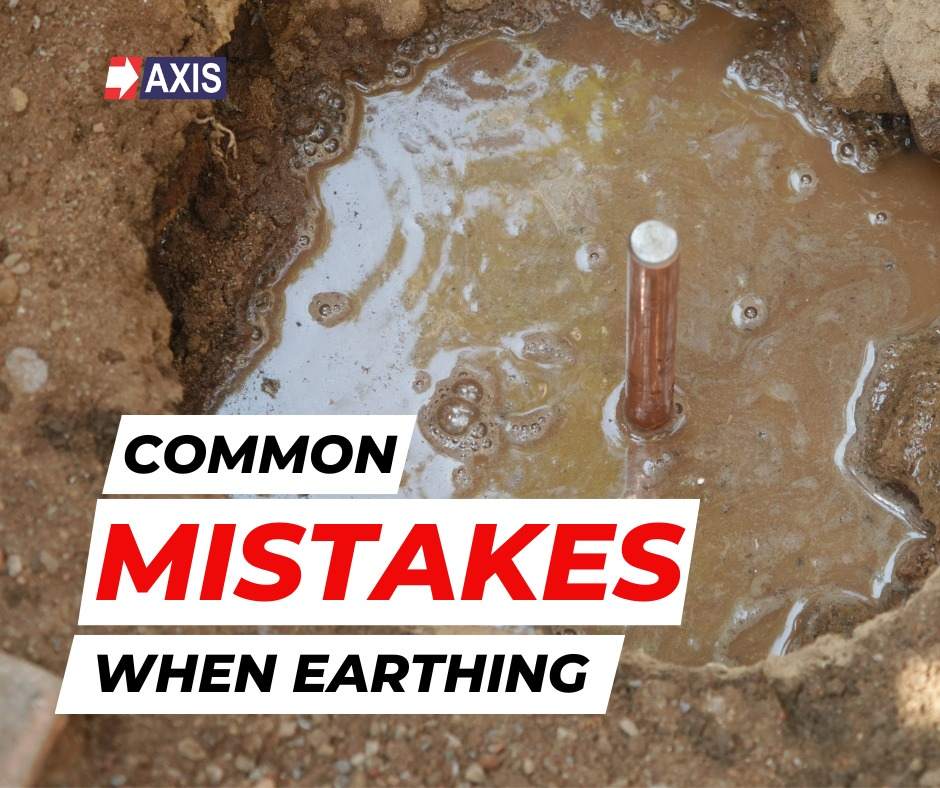
In this blog, we will discuss some common mistakes most people make while installing
earthing, so that you can avoid them.
What is Earthing?
Earthing, also known as grounding, is a process that connects your structure’s electrical system to the earth.
This provides a low-resistance path for fault currents, protecting your equipment from damage and keeping you safe
from electric shocks and fires.

Common Problems
1. Earth Enhancing Compound
This compound is made from a mix of minerals that reduces soil resistivity and retains moisture, helping maintain
consistent electrical resistance over time.
However, to save costs, some people use salt and charcoal instead. Salt becomes corrosive when ionized and requires
constant maintenance. Charcoal degrades over time and loses moisture retention. Both can damage your earth rod.
Therefore, earth enhancing compounds are strongly recommended.

Axifill earth enhancing compound is tested as per IEC 62561-7, IEEE 80, and BS 7430, ensuring reliable performance
even in extreme conditions.
2. Earth Rod
An earth rod is a metal conductor buried deep in the ground that safely dissipates fault current into the soil.
Choosing the right material is critical.

- Use solid copper rods in high-corrosion areas.
- Use stainless steel rods where galvanic corrosion is a concern.
- Use copper-bonded rods in normal soil (most commonly used).


Many people choose galvanised steel due to its low cost. However, it has limited corrosion resistance and is not
suitable for high-corrosion environments. Over time, it may fail and compromise your earthing system.

Talk to our engineers!
3. Earth Pit Chamber
An earth pit chamber is an enclosure that provides safe access to inspect, test, and maintain earthing components.
Traditional brick chambers are costly, space-consuming, and time-intensive. Instead, FRP earth pit chambers are
recommended.

FRP chambers are lightweight, easy to install, durable, and can withstand loads up to 5000 kg. They are tested
as per IEC 62561-5.
4. Clamps
Clamps connect the grounding wire to the earth rod and ensure proper electrical contact for safe current dissipation.
Copper clamps are recommended for equipment earthing due to their high conductivity. Stainless steel clamps can be
used only if they meet fault current requirements. Otherwise, they may fail under high current conditions.
By avoiding these common mistakes, you can ensure a safer and more reliable earthing system. Axis offers expert
design, installation, and testing services for earthing and lightning protection systems.