Over the past century, Electrical Safety Standards have evolved into highly advanced frameworks, covering all key aspects of safe installations, including Earthing Systems. For Low-Voltage (LV) Electrical Installations, the IEC 60364 standard ensures the protection of both personnel and property.
The IEC 60364 standard defines three main types of Earthing Systems: TT, IT, and TN. As IEC leads the global standards in electrical, electronic, and related technologies, the IEC 60364 standard serves as the highest authority for LV Electrical Installations worldwide. Consequently, many national standards recognize the three types of Earthing Systems outlined in IEC 60364. For example, the UK uses BS 7671: 2008 (IEE Wiring Regulations 17th Edition), and India follows IS 732:1989 (R2015).
The IEC 60364 standard defines the following Earthing Systems:
TT
IT
TN (with further subdivisions: TN-C, TN-S, TN-C-S)
For clarity, we refer to five types of Earthing Systems that are common worldwide.
Watch Our Video for a Detailed Explanation of all the 3 Systems!
The first letter in each system refers to the power source from a star-connected winding, while the second letter refers to the consuming equipment that requires earthing.
From the ‘Handbook of Electrical Engineering: For Practitioners In The Oil, Gas And Petrochemical Industry’ by Alan L. Sheldrake
T means that the source’s start point is directly connected to earth.
I indicates the source’s start point is isolated from earth, typically through an inductive impedance or resistance.
N refers to the neutral conductor, which is connected to earth.
S means the neutral and protective conductors are separated, requiring five conductors for a three-phase system.
C means the neutral and protective conductors are combined, requiring only four conductors for a three-phase system.
T = Direct connection to the Earth, T stands for Terra meaning earth
I = Isolated
N = Neutral
S = Separate
C = Combine
The most common systems used are TT and TN. Some countries, such as Norway, use the IT system. A summary of the Earthing Systems used for public distribution in different countries is shown below.
In the TT system, the supply source and the installation’s metalwork directly connect to earth. For overhead lines, the earth mass acts as the return path for the line. The installation must keep the neutral and earthing conductors separate, as the power distributor provides only the supply neutral or protective conductor.
The IT system does not directly connect to earth or connects through a high impedance. The key feature of the IT system is its ability to continue operating if a fault occurs between phases and earth. It is known as a ‘first fault.’ This allows the system to remain functional while other protections fail. Power distribution in substations or generators typically uses the IT system.
In the TN-S system, the system keeps the ground and neutral conductors separate throughout the distribution. The metallic covering of the cable supplying the installation serves as the protective conductor. The system connects all exposed conductive parts of the installation to this protective conductor or via the main earthing terminal.
You can read our detailed article about the TN-S Earthing System to learn more.
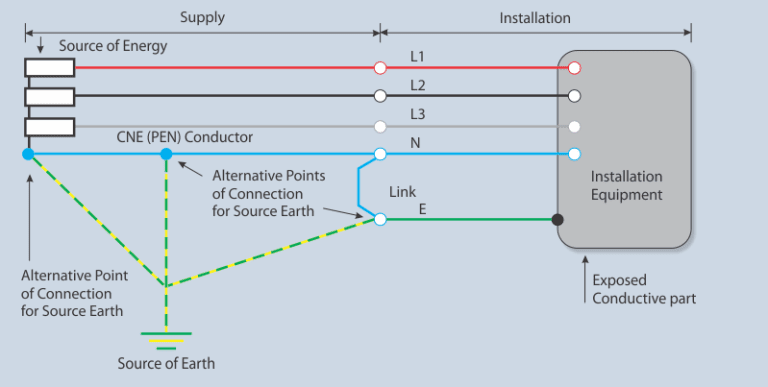
In the TN-C system, the system combines the neutral and protective earth conductors into a single conductor. The PEN conductor connects all exposed conductive parts of the installation. According to the Electricity Safety, Quality, and Continuity Regulations 2002 (8(4)), consumers must not combine neutral and protective functions into a single conductor within their installations.
The TN-C-S system combines the neutral and protective earth conductors in a single conductor at certain points in the system. This system, known as multiple protective earthing, involves earthing the supply system PEN conductor at two or more points. A near consumer’s installation may require an earth electrode. The PEN conductor connects all exposed conductive parts to the main earthing terminal, where it links the neutral and protective earth terminals.
Conclusion
Understanding the differences between TT, IT, and TN earthing systems is essential for ensuring electrical safety, reliability, and compliance with global standards such as IEC 60364, BS 7671, and IS 732. Each earthing type—whether TT with its independent earth connection, IT with isolated neutral, or TN systems (TN-S, TN-C, TN-C-S) with varying conductor configurations—serves specific operational and safety requirements depending on the installation environment.
Selecting the right earthing system not only protects personnel and equipment from electrical faults but also ensures efficient fault clearance and system continuity. When properly designed and maintained, an effective earthing system forms the backbone of any safe electrical installation.
You can view our wide range of Earthing, Grounding and Bonding Equipment here. You can contact us if you want a quotation or have any further questions regarding the products required for Earthing, Grounding, or Bonding.
This article is part of our series of articles on Lightning Protection, Surge Protection & Earthing. You can read more with the following links:
Introduction to the basics of Lightning Protection and Earthing and the Standards (IEC 62305 and UL 467)
Surge Protection Devices (SPD)
Lightning Protection Zones and their Application to SPD Selection
How does a Lightning Arrester work?
For more information, please contact us at axis-india.com/contact-us/
FAQs
1. What are the different types of earthing systems and how do they work?
The main types of earthing systems defined under IEC 60364 are TT, IT, and TN (TN-S, TN-C, TN-C-S). Each system differs in how the neutral and earth connections are configured. TT systems use independent earth electrodes, IT systems isolate the power source from earth, and TN systems connect the neutral directly to earth with variations in conductor arrangement. Choosing the right earthing system ensures electrical safety, fault protection, and compliance with global standards.
2. How does Axis Electricals help in selecting the right earthing system?
Axis Electricals provides expert guidance in choosing the most suitable earthing system—whether TT, IT, or TN—based on application, load conditions, and safety requirements. With a wide range of grounding, bonding, and lightning protection solutions, Axis Electricals ensures compliance with standards like IEC 60364 and IS 732 while improving system reliability and protection.
3. What is the difference between TT, TN-S, TN-C, and TN-C-S earthing systems?
The key difference lies in how the neutral and protective earth conductors are arranged.
TT system: Separate earth connection for the installation
TN-S system: Separate neutral and earth conductors
TN-C system: Combined neutral and earth conductor (PEN)
TN-C-S system: Combination of both, with shared conductors in part of the system
Understanding these differences helps optimize electrical safety, reduce fault risks, and improve system performance.
4. Why choose Axis Electricals for earthing and grounding solutions?
Axis Electricals is a trusted provider of earthing, grounding, and bonding solutions designed for industrial and commercial applications. Their solutions are engineered to enhance electrical safety, reduce fault risks, and meet international standards. With expertise in lightning protection and earthing system design, Axis Electricals supports reliable and compliant installations across various industries.
Split bolt connectors join conductors and carry current through the connection point. If the joint…
You are working on a live line and taking a connection using an Insulation Piercing…
Your PV modules are the most exposed and most critical part of your solar plant.…
An Early Streamer Emission Lightning Arrester, this technology offers safety from direct lightning strikes. The…
Have you ever noticed how cables safely enter and exit electrical enclosures? This is made…
Heat shrinkable products are polymer components that shrink when you apply heat. During manufacturing, we…