Choosing the right Cable Gland shouldn’t be a puzzle. Here’s a shortcut for you. Do you ever wonder how cables safely enter and exit electrical enclosures? A small but crucial component, the Cable Gland makes this possible. In this blog, we will discuss how to select Cable Glands from size chart.
Cable glands are also known as mechanical cable entry devices. They are essential components in any electrical wiring system, as they provide a secure and waterproof connection for cables.
These glands are designed to fasten and seal the end of an electrical cable to the equipment.
Certain types of cable glands also prevent flammable gas entry into equipment used in hazardous areas.
Glands can be divided into 2 major categories – Metallic & Non-metallic.
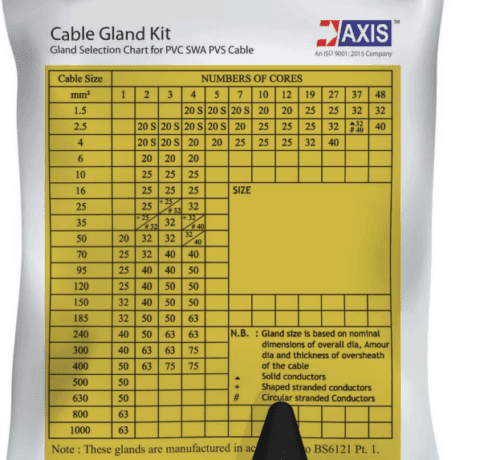
Note – The cable gland size is based on the nominal dimensions of overall diameter and armour diameter.
We will understand the selection by referring to this table.
The values in the rows show the cable cross-section area in mm² and those in the columns show the number of cores in the cable.
Step 1– Select the cable size you have from the values in the rows.
Step 2– Find the number of cores in the cable from the columns.
Step 3– Identify the corresponding cell or box, which will show the appropriate cable gland size.
For example, for a 25mm² cable with 4 cores, we get the cable gland size as 32.
Similarly, for a 35mm² cable with 2 cores, the size will be 25 or 32.
I hope you now have a clear understanding of selecting cable glands from the size chart.
Improper cable gland installation can lead to short circuits and fire. You can learn the correct installation techniques by watching our video on BW Brass Cable Glands installation on Steel Wire Armoured Cables.
Axis offers you a wide range of Fasteners manufactured from quality material and tested based on industry standards. Standard products, as well as customized products, are available according to customer requirements. Get more details about our Fasteners on our Product page.
Thank you for reading the blog, Axis is a leading manufacturer and supplier of Electrical Components to over 80+ Countries. Talk to our industry expert by visiting our contact us section. You can also watch our videos by our experts – click here.
Follow us on LinkedIn for regular updates on our Products!
Split bolt connectors join conductors and carry current through the connection point. If the joint…
You are working on a live line and taking a connection using an Insulation Piercing…
Your PV modules are the most exposed and most critical part of your solar plant.…
An Early Streamer Emission Lightning Arrester, this technology offers safety from direct lightning strikes. The…
Have you ever noticed how cables safely enter and exit electrical enclosures? This is made…
Heat shrinkable products are polymer components that shrink when you apply heat. During manufacturing, we…