
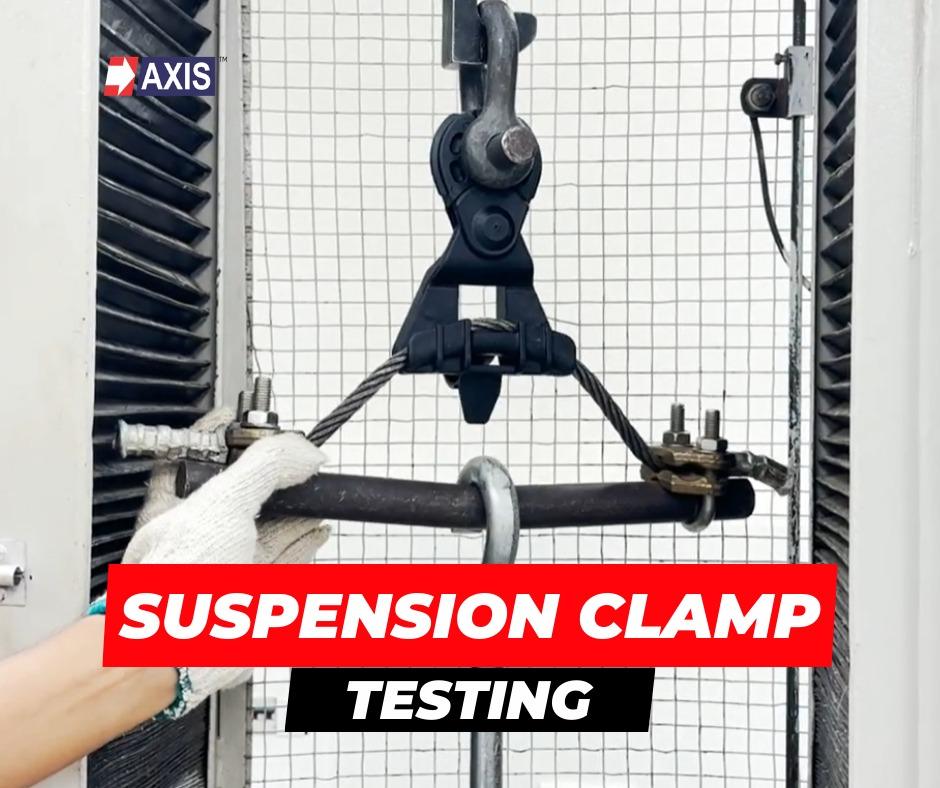
In this blog, you will learn how to perform three important tests on suspension clamps,
- High Voltage Test
- Slipage Test
- Tensile Test
Why are tests important?

Suspension clamps support and hold the messenger cable in an Aerial Bundled Cable system. They carry electrical and mechanical loads under harsh outdoor conditions. These tests confirm that the clamp provides proper insulation, mechanical strength, and grip during real service conditions.
Note: Always use the proper fixtures, torque tools, and protective equipment during testing.
Di-electrical Voltage Test
This test is performed as per BS EN 50483. Its goal is to verify that the suspension clamp keeps its insulation intact, and does not break down electrically, after mechanical or environmental stress.
Step 1: Prepare the test sample of the insulated neutral messenger and the suspension clamp. Ensure the cable sheath and clamp surfaces are clean and dry before testing.

Step 2: Wrap a conductive foil, or wire, around the insulated neutral messenger of the maximum cross‑section designed for the clamp.
Step 3: Insert the assembly into the clamp. Connect the conductive foil to the high‑voltage terminal. Earth the conductive parts of the clamp, or its metallic fixing point.

Step 4: Gradually increase the alternating current test voltage to 6 kilovolts, at a rate of approximately 1 kilovolt per second. Maintain the voltage for 60 seconds. The maximum leakage current shall be equal to ten milliamperes ± 0.5 milliamperes.

Observe the sample during testing. The clamp passes if there is no flashover, no breakdown, and no surface discharge. As you can see, the Axis suspension clamp completed the test without any failure. This confirms that the clamp maintains dielectric integrity and electrical insulation under service conditions.
Talk to our engineers!
Slip Test as per BS EN 50483-3
Step 1: Mount the suspension clamp on a section of insulated neutral messenger cable. Mark the messenger at the point at which it leaves the clamp.

Step 2: Gradually apply a longitudinal load to the neutral messenger and increase it to 300 newtons. The total slip of the neutral messenger cable does not exceed 2 millimetres.

The clamp passes if no damage occurs. No component of the clamp shall be dislodged. As you can see, the cable has not slipped from the clamp’s marking. This shows it has passed the test and the gripping is perfect.
Tensile Test as per NFC 33 040
This test checks the mechanical strength of your suspension clamp under full tension.
Step 1: Mount the clamp in the tensile testing machine with the load aligned to the clamp fixture. Tighten the grips and ensure it is securely held in the fixture.

Step 2: Apply the load gradually up to nine point 6 kilonewtons. Hold for one minute and then take it up to 12 kilonewtons. The clamp passes the test if there is no visible deformation, cracking, or fracture.

As you can see, the Axis suspension clamp has completed the test without any failure because there is no visible deformation, cracking, or fracture.
We hope you now have a clear understanding of how to test your suspension clamps. This test is performed at our Axiom Lab in Mumbai, which is accredited by the National Accreditation Board for Testing and Calibration Laboratories (NABL) for ISO 17025-2017 and approved by Underwriters Laboratory (UL).
Thank you for reading and if you found this informative, then feel free to contact us to get a quote or to know more about our products; visit our product section at https://axis-india.com/products/