
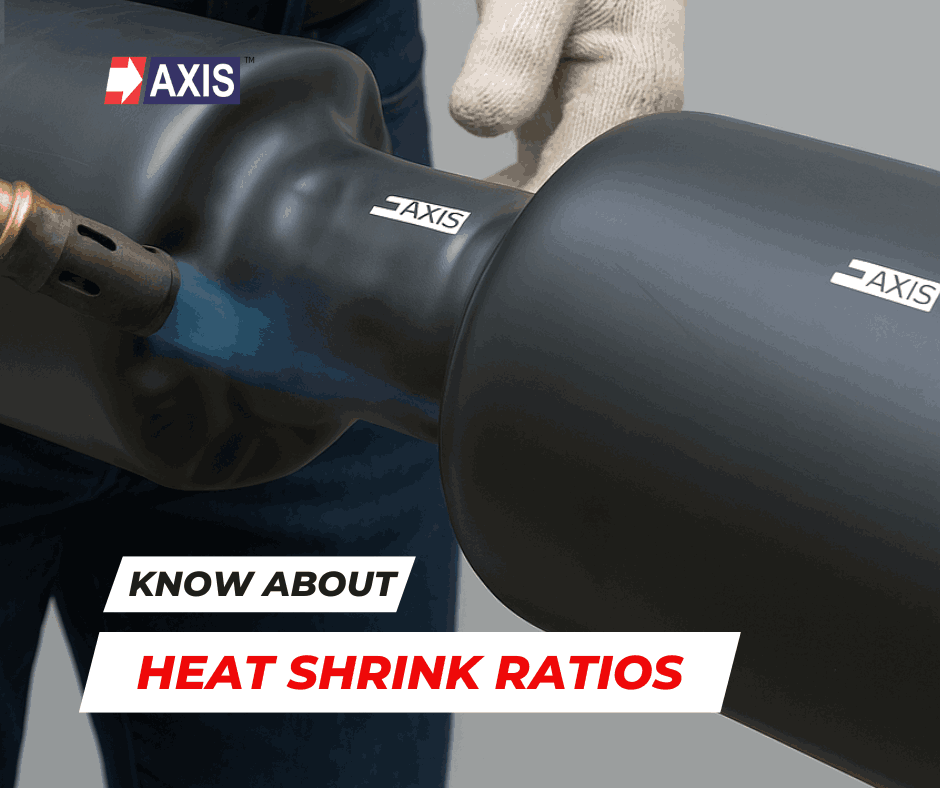
Shrink Ratios play a crucial role in the performance and selection of heat shrinkable products. Whether you’re working with uniform wires or irregular cable joints, understanding shrink ratios helps ensure proper fit, insulation, and long-term reliability. This blog explains what shrink ratios are, their common applications, and how they influence the selection of heat shrink tubing in electrical installations.
By the end of this blog, you will understand:
- What are these ratios?
- Their applications
- And how they influence your decision when buying any Heat Shrinkable Product.
Introduction

Heat shrinkable products are made up of crosslinked thermoplastic elastomers that contract or “shrink” when exposed to heat. This characteristic allows them to tightly wrap around electrical conductors and termination parts, providing insulation, weather stability and chemical resistance.
When we talk about heat shrink tubing, one aspect that matters most is the Shrink Ratios. It tells you how much the tubing will shrink when heat is applied.
Imagine you are working with a power cable that has a thick lug at one end and a thinner cable section behind it. You need one tube that can slide over the connector and still shrink down tightly around the cable. Standard tubing won’t cover both properly. You need something that can handle that size difference without leaving gaps.
This is where Shrink Ratios come in. These ratios tell you how much the tube reduces in diameter when heat is applied, allowing a single tube to adapt to different sizes along the same length.
Let me give you an example. If a single-wall tubing has a shrink ratio of 2:1, it means the tubing will shrink to half its original diameter when heated. If a tube starts at 10 mm in diameter, it will shrink down to 5 mm. This allows it to grip tightly onto wires, terminals, or connectors of different sizes.
This shrinking behaviour is built into the material during manufacturing. The polymer is stretched and cooled in its expanded form. When reheated, it remembers its original size and contracts back to it, gripping the surface like a second skin.
Talk to our engineers!
Application

Different applications demand different Shrink Ratios. Let’s understand the application of some standard ratios.
2:1 – The Standard Choice
Starting with 2:1. This is the most commonly used. It works well for uniform wires, terminals, and small components. If you are insulating standard joints in control panels or organizing cables in a harness, 2:1 gives a clean and reliable finish.
3:1 and 4:1 – For Irregular Shapes
But not all connections are standard. That’s where 3:1 or 4:1 comes in. These ratios are designed for irregular shapes, thicker connectors and uneven joints. They allow the tubing to stretch over larger parts and then shrink down to tightly seal thinner sections.
6:1 – For Extreme Size Differences
In high-demand environments, even 4:1 might not be enough. That’s when 6:1 is used. It handles extreme variations in diameter – like thick cable lugs paired with smaller conductors. You will find this ratio in high-voltage installations.
7:1 and 12:1 – Specialized Applications
For highly specialized needs, there are even higher ratios like 7:1 or 12:1. These are used in rare cases, where the size difference between components is extreme or when covering damaged insulation. You will find these used in aerospace, defense, or custom repair work, where standard tubing just won’t do the job.
Higher shrink ratios also make installation easier. They allow one tube to fit over large connectors and still shrink enough to grip smaller sections. This makes it easier to handle cables with uneven shapes or mixed sizes and saving time.
We hope you now have a clear understanding of shrink ratios and their applications. Always ensure that the selection and installation of heat shrink components are carried out by trained and authorized professionals.
At Axis, we have a team of 50+ engineers who can help you with choosing, applying, and testing heat shrink solutions. Our products are installed worldwide in solar farms, substations, data centers, factories, and in everyday residential and commercial projects.
Thank you for reading and if you found this informative, then feel free to contact us to get a quote or to know more about our products; visit our product section at https://axis-india.com/products/